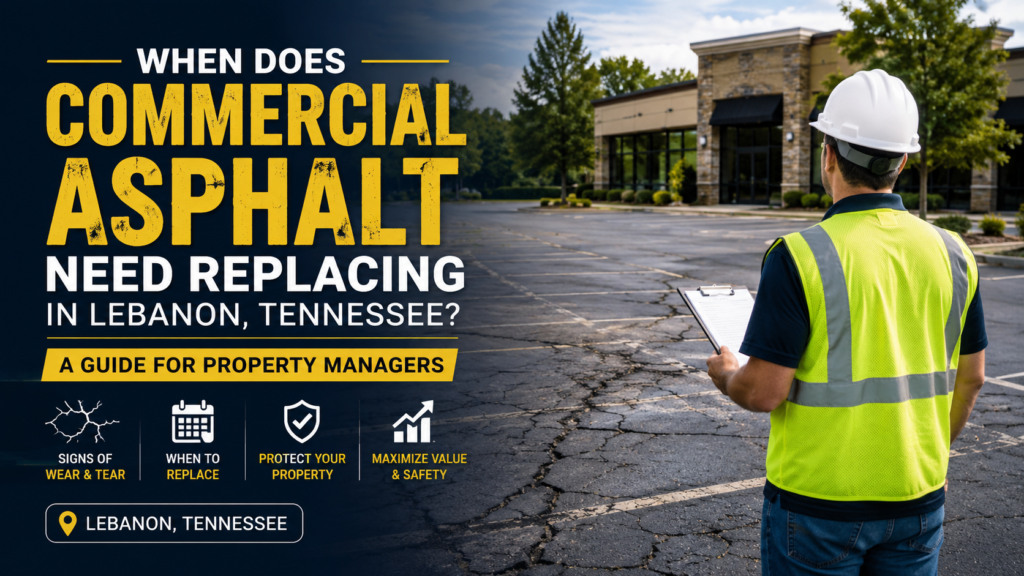
Commercial parking lots in Lebanon, Tennessee take a harder beating than residential driveways. They serve far more vehicle movements per day, expose the pavement to heavier vehicles delivery trucks, service vehicles, customer and employee cars and must perform reliably and safely every day the business they serve is open. Wilson County Middle Tennessee climate adds its own demands: periodic freeze-thaw cycling, 50 inches of annual rainfall, and Tennessee clay soils that move seasonally beneath the pavement. The question that property managers and Commercial Asphalt Replacement Lebanon property owners face regularly is: when should a parking lot or access road be resurfaced, and when has deterioration progressed to the point where full replacement is the only appropriate answer? Understanding the difference between these two interventions and recognizing which one the current condition warrants is both a financial and a safety decision.
The Difference Between Resurfacing and Full Replacement
Before addressing when replacement is needed, it is important to be clear on what distinguishes resurfacing from replacement. Resurfacing also called overlay involves applying a new layer of hot mix asphalt over the existing pavement surface. The existing base and sub-grade remain in place. Resurfacing extends pavement service life by 8 to 15 years at a fraction of full replacement cost. It is appropriate when the existing base is structurally sound and the pavement distress is limited to the wearing surface layer.
Full replacement involves removing all existing asphalt, evaluating and correcting the base and sub-grade as needed, and installing a complete new pavement structure. It is necessary when the base has failed, when water has infiltrated and compromised the sub-grade, or when the extent of structural distress throughout the lot makes surface treatment or overlay ineffective.
Choosing overlay when replacement is actually needed is one of the most common and costly pavement management mistakes in the commercial sector. An overlay applied over a failed base will re-crack in the same locations within two to three years, because the base failure that created the surface distress has not been corrected. Property managers who understand the distinction protect their capital budgets from this expensive error.
The Signs That Warrant Full Replacement
Several specific indicators signal that a Lebanon commercial parking lot has progressed beyond the point where resurfacing is appropriate and replacement is the correct intervention:
- Alligator cracking (fatigue cracking): Interconnected surface cracks forming a pattern resembling alligator or crocodile skin are the classic indicator of base failure. This cracking pattern occurs when the base material has lost its structural integrity and the asphalt surface is flexing under vehicle loads with insufficient support. Alligator cracking that covers more than 25 to 30 percent of the lot surface, or that is concentrated in regularly trafficked areas such as drive aisles and entry/exit points, indicates base failure that overlay will not correct.
- Extensive pothole formation: Potholes that recur quickly after patching, or potholes distributed across large areas of the lot rather than isolated to occasional spots, indicate base failure beneath the potholes. Patching these areas is a temporary fix; the base is saturated and structurally compromised.
- Rutting and depression in traffic lanes: Permanent deformation of the pavement surface ruts or depressions in the wheel tracks of regularly trafficked lanes indicates either that the base has failed under traffic loading or that the original asphalt mix was not appropriate for the temperatures and loads the lot experiences. Rutted surfaces that are more than 1 to 2 inches deep typically require full-depth reclamation or replacement.
- Edge deterioration that reveals the base: When the edge of a parking lot has crumbled away to the point where the aggregate base material is visible, the structural integrity of the adjacent pavement is compromised. Widespread edge failure indicates that lateral drainage and edge support have been inadequate for years, and the damage extends inward.
- Widespread subsidence and drainage failure: Areas of the lot that have settled unevenly, creating low points that collect standing water after rain events, indicate base settling or sub-grade failure. Standing water on commercial pavement is not merely an aesthetic problem it rapidly accelerates freeze-thaw damage, infiltrates into the base, and shortens remaining pavement life.
Conditions That Allow for Resurfacing Instead
Resurfacing is appropriate when the base remains structurally sound when the deterioration is primarily a surface-layer issue:
- Moderate surface cracking that does not extend into the base: Linear cracks, edge cracks, and isolated block cracking that are confined to the asphalt surface layer can be repaired with crack filling before the overlay is applied. This prevents the cracks from reflecting through the new surface layer too quickly.
- Surface oxidation and raveling: Gray, faded asphalt with surface raveling (loss of fine aggregate from the surface) and minor cracking indicates UV-driven binder oxidation. The structure is intact; only the surface has aged. Overlay with proper preparation and crack filling addresses this condition appropriately.
- Isolated pothole repair areas: A lot with otherwise sound base but several localized pothole areas can have those areas patched as part of pre-overlay preparation, with the overlay then applied over the sound surrounding pavement.
The Timing Decision for Lebanon Commercial Properties
For commercial properties in Lebanon retail centers, office parks, industrial facilities, apartment complexes, and institutional properties the decision about when to replace commercial asphalt has a direct financial dimension. Full replacement is significantly more expensive than overlay. However, deferring replacement past the point when overlay would have been appropriate results in accelerating damage that increases the eventual replacement scope and cost. The commercially optimal timing is to overlay when the surface warrants it and the base remains sound, and to replace promptly when base failure indicators appear before further service causes the sub-grade to deteriorate as well.
Commercial property owners and managers in Lebanon planning pavement improvement projects benefit from working with asphalt contractors who perform honest condition assessments including taking core samples to evaluate base condition when surface indicators are ambiguous rather than recommending the less expensive option regardless of what the condition actually warrants.
Conclusion
Commercial asphalt replacement in Lebanon is warranted when alligator cracking, extensive pothole recurrence, rutting, or widespread subsidence indicate that the pavement base has failed and overlay will not provide a durable solution. Understanding the difference between replacement and resurfacing, recognizing the specific distress patterns that signal each, and making the timing decision based on honest structural assessment rather than surface appearance alone positions Lebanon commercial property managers to make pavement decisions that balance investment efficiency with the safety and functionality that commercial operations require.